
I want to address what far too many articles about transitioning into an “alternative” career don’t talk about. Most articles talk about the “hard”, concrete stuff, like career options or networking. However, the truth is that the hardest part about leaving academia is the emotions that come with it.
There are a few people I’ve talked to who have never been anything but thrilled to leave academia. Often these people know very early on that that route isn’t for them, perhaps even before starting their PhD. Most of us, though, go into a PhD with the goal of becoming a professor. We fell in love with research, probably as undergrads, and we thought it would be wonderful to do it for the rest of our lives. Then at some point, we realize that path just isn’t for us. Maybe we realize staying in academia means writing grants for the rest of our lives, or we confront the realities of just how hard it is to get that tenure-track faculty position. Maybe we learn that a postdoc salary just won’t be enough to support a family, or that we’re not willing to chase temporary contract after contract. Maybe we simply realize it’s just not for us, or it’s not what we want to do for the rest of our lives.
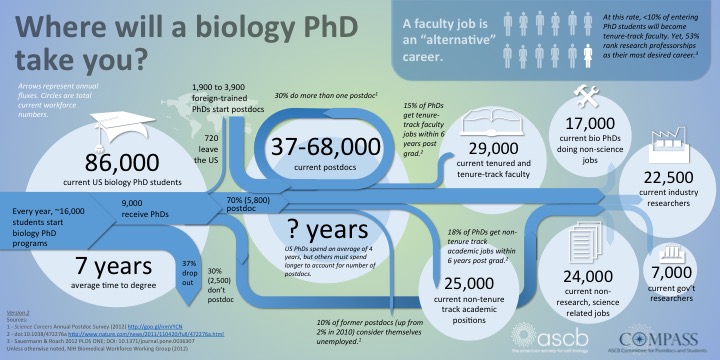
Whatever the reason, it’s important to understand that leaving academia is a major decision that usually comes with messy emotions. Here are three common, but very complex, feelings you may be having about leaving academia:
1) Feeling like a failure
Often academia sends trainees the message that a faculty position is the only route to success, and that people who’ve ended up doing other things with their life are failures somehow. It’s often implicit rather than explicit, but the message is clear.
It’s important to remember that it’s extremely natural and normal to feel this way if you’re considering leaving academia (or even just pursuing a non-faculty position). You’ve probably wanted to pursue a career in academia for a long time at this point, and you feel awful for not achieving it – even if you acknowledge that it’s just not for you (see “sunk cost fallacy”). People who don’t have supportive mentors and peers are especially vulnerable to feeling this way.
While it can take years to stop feeling like a failure for not “making it”, there are several ways to speed up the process and make it less painful. Firstly, take some time to really think about what success means to you. A former mentor of mine asked me this when I was trying to figure out what to do after grad school. I thought it was a silly question at the time, but years later I realized it was probably one of the most important things to figure out in my career and my life. At the end of the day, only you can decide what success means: is it having financial stability? A job where you get to travel the world? Being able to live in a city you love? Having a family? Helping others? Chances are, if you’re reading this, your definition of success doesn’t necessarily involve running your own lab, gaining tenure, or winning research grants. For myself, I realized my definition of success meant helping make science and technology accessible to people, being financially stable, and being in charge of my own life and career. Once I worked out that those goals weren’t necessarily in sync with an academic career, the decision to leave and pursue new goals was easy.
Secondly, make sure you have a supportive network around you. If you’re surrounded by people who don’t see the value in an alt-ac career and question your life choices, it’s time to build a new support network. Talk to former students who have made a similar leap, reach out to industry mentors, go to meetups. Making the transition is hard enough; having a support network on your side will make it easier.
2) Feeling like a sellout
For some people in academia, anything done for reasons other than the pursuit of knowledge is considered “selling out”. While it would be nice for society to provide more opportunities for people to pursue this worthy goal, a) that’s just not how it works in real life, b) it’s hard to pay the bills on an academic salary, and c) there are so, so many worthy, hard problems that need solving in this world, and academia isn’t always the best place to work on them anyway.
Rather than worrying about “selling out”, ask yourself what your values truly are and how you can align your career choices with those values. If you truly believe that private industry is immoral and shouldn’t be involved in scientific research, there are plenty of jobs in non-profits, funding agencies, scientific journals, and the like. If you want to go into sales but decide you draw the line at being a pharma sales rep, there are lots of jobs that don’t involve selling pharmaceuticals. If you’re more of an editor type and believe scientific publications should be accessible to all, you can rule out working for a paywalled journal. Making peace with your personal values lets you choose the career that works for you and makes taking criticism a lot easier.
An aside here: many people think leaving academia means selling out because they think that an industry position = better paycheck. While generally true in the long term, not everyone reaps the benefits immediately. You may even take a pay cut if you’re transitioning to a completely different field and have to start over.
3) Feeling lost, confused, terrified and/or overwhelmed
You’re not alone! Most people who leave academia feel like this at one point or another, especially if they haven’t been exposed much to life outside academia. I started this blog to help people feeling this way, because I was once there myself too.
It can feel like there’s a lot to learn, but remember that you can totally take baby steps. Got 5 minutes today? Read one article about a career you’re interested in. Fifteen minutes? Send an email to someone you’d like to get coffee with, or work on that Python course. An hour? Work on your resume, or go to that career fair on campus. You don’t have to drop everything right now to read about every single career path or learn every single skill you think you might need. Unless you’ve graduated and your only focus is actively job hunting, you’ll have to balance this process with your daily responsibilities, so play the long game and just do what you can today.
Whether you’ve felt all of the above, some, or none, it’s important to acknowledge that your emotions are valid. If you’re struggling and need further help, please reach out to your support network and consider speaking to a counselor or other mental health professional.
Further reading:
There’s No Shame In Leaving Academia
Walking Away From Academia When It Was Your Dream Job
You Are Not A Failure For Wanting To Leave Academia
The Emotional Side of Leaving Academia
Inside and Outside the Academy: Valuing and Preparing PhDs for Careers
 I Have A PhD, Now What?